 By Zoltan · Creator of Faded Main Street, a YouTube channel documenting vanished Americana — ghost signs, lost buildings, and discontinued products. | Last updated: July 2026
What are ghost signs? A ghost sign is a faded, hand-painted advertisement — usually 60 to 130 years old — still clinging to a brick wall, preserved largely by the lead-based paint that traveling sign painters called “wall dogs” used between the 1890s and the 1950s.

Key Takeaways
- Ghost signs are hand-painted wall advertisements from roughly the 1890s–1950s that survive in faded form on brick buildings across nearly every American town.
- Coca-Cola’s first painted wall ad went up in 1894 on Young Brothers Pharmacy in Cartersville, Georgia — the company went on to commission as many as 16,000 wall murals nationwide.
- One painter, Harley Warrick, painted or retouched more than 20,000 Mail Pouch Tobacco signs across 13 states over a 55-year career.
- The signs survive because of chemistry: white-lead pigment in linseed-oil paint bonds to porous brick and resists weather for a century — modern paints fade in 10–15 years.
- The term “ghost signs” was popularized by William Stage’s 1989 book Ghost Signs: Brick Wall Signs in America, the first serious documentation of the phenomenon.
- The trade collapsed after the 1950s under neon, vinyl lettering, and the 1965 Highway Beautification Act — though an 1974 amendment spared signs designated “landmark signs” of historic or artistic significance.
- In Detroit, demolition crews keep uncovering pristine ghost signs hidden for a century behind neighboring buildings.
What Are Ghost Signs?
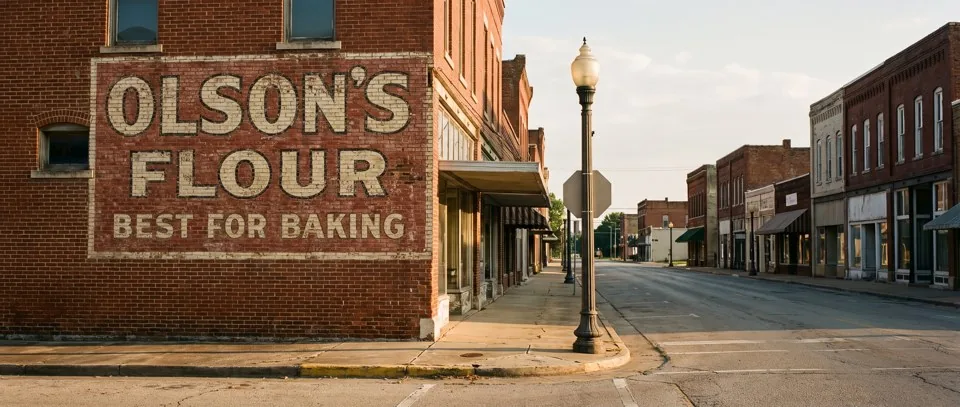
Ghost signs are the faded remains of hand-painted outdoor advertising — building-sized ads for flour, tobacco, soft drinks, overalls, and hotels, painted directly onto brick between roughly 1890 and 1960. They are sometimes called “fading ads” or “brickads,” and together they form what may be the largest outdoor art gallery in America — one that almost nobody realizes they’re walking through.
The name describes what time did to them. When the businesses closed, the signs weren’t removed; they simply faded, flaking yet clinging to the wall, growing fainter until they became spectral images — still present, but barely. Ghosts of an economy that no longer exists.
The term itself has a traceable origin. Writer and photographer William Stage catalogued the phenomenon systematically in his 1989 book Ghost Signs: Brick Wall Signs in America — per the UK Ghostsigns archive, the earliest use of the term “ghost sign” in a commercially distributed book, and the first serious cultural documentation of the fading murals.
Where Did Ghost Signs Come From?
Ghost signs are a product of a specific media vacuum. Picture America in the 1890s: no radio, no television, no neon. If a company wanted to reach thousands of people at once, it had exactly one mass medium available — the blank brick wall facing a busy street. Blank walls were advertising real estate, and in an era with almost no signage regulation, companies raced to claim every square foot of brick.
National sign companies — outfits like the Thomas Cusack Company of Chicago — employed entire traveling crews of painters and dispatched them across the country like advance units of a commercial army. The products they painted read like a lost dictionary of American life: Owl Cigars, King Midas Flour, Bruton’s Snuff, Can’t Bust ‘Em Overalls, and Mail Pouch Chewing Tobacco, made by the Bloch Brothers Tobacco Company of Wheeling, West Virginia, whose barn signs became a roadside institution in their own right.
Who Were the Wall Dogs?
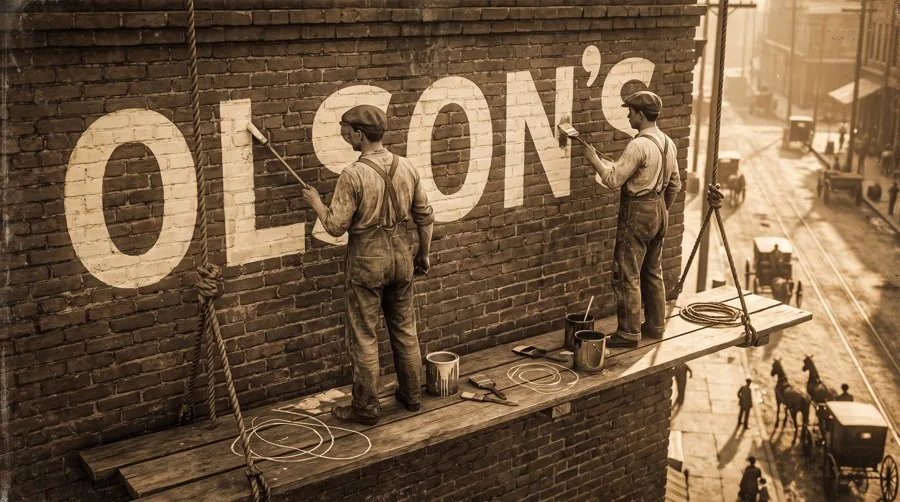
The wall dogs were the traveling craftsmen who painted the signs — men who said they worked like dogs, tethered to walls on wooden scaffolds and rope rigs, sometimes fifty feet above the street, in summer heat and autumn wind. They moved from town to town like journeymen, carrying brushes, chalk lines, and buckets of paint, and a crew could put up a building-sized advertisement in a day or two.
They weren’t just laborers. Their greatest technical challenge sounds simple and isn’t: making enormous lettering appear perfectly straight and level on walls that were anything but. Crooked bricks, uneven mortar, bowed surfaces — the wall dog’s job was to make imperfection look like precision, using nothing but a practiced eye and a steady hand.
The most famous of them was Harley Warrick, who spent 55 years painting Mail Pouch Tobacco signs on barns across the Midwest and Appalachia. Over that career he painted or retouched more than 20,000 Mail Pouch signs across 13 states — signs had to be repainted every three or four years, so the count of distinct barns is far lower — roughly 4,000. He became so identified with the work that some of it has been exhibited by the Smithsonian Institution, and he appeared on Good Morning America and Charles Kuralt’s On the Road. When he put down his brush in the early 1990s, he was the last of the Mail Pouch barn painters in America.
What Did Coca-Cola Have to Do With It?
More than any other company, Coca-Cola industrialized the painted wall. In 1894, a syrup salesman painted the company’s first wall advertisement on the side of Young Brothers Pharmacy in Cartersville, Georgia — a sign authenticated by the Coca-Cola Company as the first outdoor painted wall ad in its history, and still on view today.
It would not be the last. Coca-Cola effectively ran a nationwide painting operation — standardized designs, registered colors, traveling crews — and by one company-cited estimate commissioned as many as 16,000 painted wall murals across the United States. By 1910, a quarter of the company’s advertising budget went to wall murals. Some of those walls are still legible today, more than 120 years later.
Why Are Ghost Signs Still Visible After 100 Years?
Lead. The paint the wall dogs used was loaded with it — typically white-lead pigment (Dutch Boy was the famous brand) mixed into linseed-oil paint. Lead paint was prized for exactly the qualities that made these signs immortal: it gripped porous brick with incredible tenacity, resisted rain and sun, and held its color decade after decade.
The scale of it is hard to believe. One sign painter, describing a single enormous advertisement, said the crew used a ton of lead just for the period at the end of the sentence. A ton of lead — for punctuation.
The irony is complete: the same toxic metal that was eventually banned from house paint is the main reason this outdoor museum still exists. Modern paints fade in ten or fifteen years. Lead paint stays — fading slowly, sinking into the brick, becoming a ghost instead of disappearing. The signs survive because they are, quite literally, poisoned into permanence.
What Is a Ghost Sign Palimpsest?
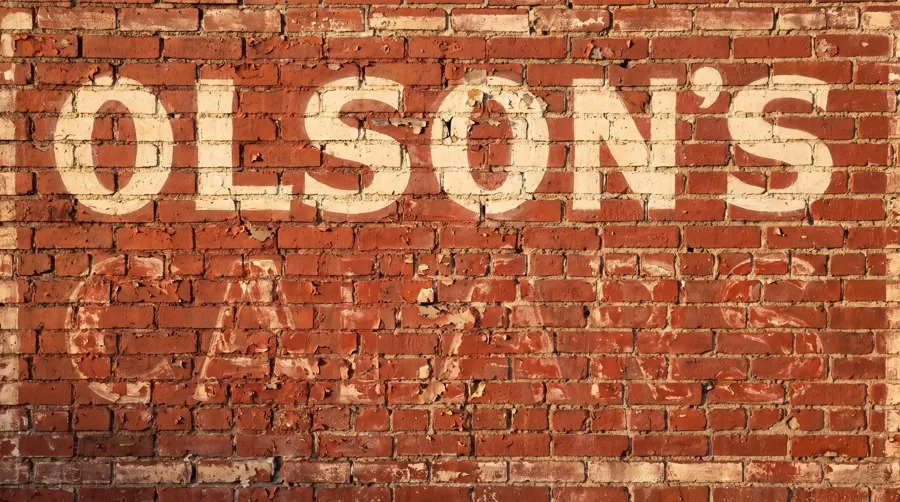
A palimpsest is a wall carrying more than one ghost sign at once, the layers bleeding through each other as they fade at different rates. Advertising space was rented, and when one contract ended, another company simply painted its message directly over the last one. Today you can find a 1920s tobacco ad surfacing through a 1950s soda ad — two eras of American commerce arguing with each other in fading paint.
Preservationists borrowed the term from ancient manuscripts: a palimpsest was a parchment scraped clean and written over, with the old text still faintly visible beneath. Some walls carry two, three, even four advertisements from different decades, tangled together like double-exposed photographs.
What Killed Hand-Painted Wall Advertising?
Three things, in quick succession — and the timeline below is the whole rise and fall in one view.
First came the competition. By the 1950s, electric signage and glowing neon made painted walls look old-fashioned overnight. Why hire a crew of painters when a sign could shine in the dark?
Second came technology. Mass-produced vinyl lettering and printed billboards meant ads could be manufactured in a shop and installed in hours — no scaffolds, no brushes, no wall dogs.
Third came the law. In 1965, President Lyndon Johnson signed the Highway Beautification Act — nicknamed “Lady Bird’s Bill” after First Lady Lady Bird Johnson, who championed it — a sweeping effort to control outdoor advertising along the new interstate highways. Within a generation, an entire trade had almost completely disappeared. The men climbed down from the walls, and for the most part, they never went back up.
The Act banned advertising signs within 660 feet of an interstate highway, and a great many Mail Pouch barns stood inside that radius — painted over, torn down, or simply left to go. But in 1974 Congress amended the law, at the urging of West Virginia Senator Jennings Randolph, to carve out an exemption for “landmark signs.” Under 23 U.S.C. § 131, signs lawfully in existence on October 22, 1965 could be spared if a state — subject to the approval of the Secretary of Transportation — determined them to be landmark signs, “including signs on farm structures or natural surfaces, of historic or artistic significance.” The reasoning was that some outdoor advertising had become part of the American folk heritage. It is a statutory category, not a National Park Service designation — but it is why so many Mail Pouch barns are still standing.
Can a Ghost Sign Come Back From the Dead?
Yes — and it happens by accident. In Detroit, as abandoned buildings are demolished through the Detroit Land Bank Authority’s blight-removal program, wrecking crews keep making accidental discoveries: when a building comes down, the wall of its neighbor sees daylight for the first time in a century — and there, protected all those years by the building pressed against it, is a pristine ghost sign. Colors still strong. Letters still sharp. An ad that last saw the sun when the building next door went up, suddenly selling its long-vanished product to a city that had forgotten it existed.
Demolition — the very force that has erased thousands of these signs — occasionally works in reverse: a wrecking ball acting as an archaeologist.
Should Ghost Signs Be Restored — or Left to Fade?
This is the genuine dilemma at the center of ghost sign preservation, and preservationists argue about it to this day. When you repaint a ghost sign, is it preserved — or is it gone?
| Restore (repaint) | Leave it alone | |
|---|---|---|
| What you save | The image: bright, legible, permanent | The artifact: original paint, real weathering |
| What you lose | The evidence — a century of fading is erased | Eventually everything; weather finishes what time started |
| Who does it | Revival sign painters matching registered historic colors | Documentarians — photographing and mapping before it’s gone |
| Example | Coca-Cola Consolidated’s mural restorations | Most ghost signs in most towns |
The restoration movement is real and growing. Institutions like the American Sign Museum in Cincinnati and the International Walldog Mural & Sign Art Museum in Pontiac, Illinois preserve both the physical signs and the techniques used to create them. A small revival of the craft itself has emerged: modern artists who trace surviving letterforms, research the exact colors companies registered a century ago, and repaint walls the way the wall dogs would have. It is meticulous, almost archaeological work.
But a freshly painted replica is bright and permanent, while the ghost — the fading, the hundred years of rain visible in the paint — was the historic artifact. Repaint it and you’ve saved the image but erased the evidence. Leave it alone and in a few decades there may be nothing left to save. There’s no clean answer. Every faded wall forces the same quiet choice between memory and authenticity.
How Do You Find Ghost Signs Near You?
Ghost signs aren’t in museums. There’s no plaque, no admission fee, no velvet rope. They’re just there — above the coffee shop, behind the parking lot, on the alley side of the hardware store. Here’s where to look on any old American Main Street:
- Look up. The second and third stories of commercial blocks, above the modern storefronts, are where most survivors hide.
- Check alley walls and exposed sides of corner buildings — the big blank facades that faced traffic a century ago.
- Watch demolition sites. A newly exposed party wall is the single best place to find a well-preserved sign.
- Chase the light. Faded lettering often becomes legible only in low, raking sunlight — early morning or golden hour.
- Photograph what you find. Every ghost sign is fading on a timescale of decades; documentation is preservation.
See These Signs in Motion
The Faded Main Street project documents America’s ghost signs — the wall dogs, the brands, and the walls they left behind — in short documentary films. Start with the story behind the project, or watch on YouTube.
Ghost Signs FAQ
Why are they called ghost signs?
Because the ads faded rather than disappeared — spectral images of businesses that closed generations ago, still faintly visible on the wall. William Stage’s 1989 book Ghost Signs: Brick Wall Signs in America gave the phenomenon its name.
How old are most ghost signs?
Most date from roughly the 1890s through the 1950s — the golden age of hand-painted wall advertising, before neon, vinyl lettering, and the 1965 Highway Beautification Act ended the trade.
What is a wall dog?
A wall dog was a traveling sign painter — so named because the men worked like dogs, tethered to scaffolds sometimes fifty feet above the street. Crews could paint a building-sized ad in a day or two, and their core skill was making huge lettering look perfectly straight on crooked brick.
Why does the old paint last so long?
Chemistry. White-lead pigment mixed into linseed-oil paint bonds tenaciously to porous brick and resists sun and rain for a century. Modern paints fade in 10–15 years; lead paint just slowly sinks into the brick.
Are ghost signs dangerous because of the lead?
The lead is bound up in weathered paint high on a wall, so simply looking at ghost signs poses no meaningful risk. The hazard historically fell on the painters who handled white lead daily — one reason lead paint was ultimately banned from consumer use.
What was the first Coca-Cola wall sign?
Painted in 1894 on the side of Young Brothers Pharmacy in Cartersville, Georgia, by a Coca-Cola syrup salesman. The Coca-Cola Company has authenticated it as the first outdoor painted wall ad in its history, and it’s still there today.
Is it legal to restore a ghost sign?
Generally yes, with the building owner’s permission — though some towns treat ghost signs as historic resources with review requirements. The harder question is whether repainting preserves the sign or replaces the historic artifact with a replica; preservationists remain divided.
Zoltan — Creator of Faded Main Street, a YouTube channel documenting vanished Americana — ghost signs, lost buildings, and discontinued products.