Why teenagers hung out at the mall in the 1980s? Because it was the only warm, free, unsupervised room in the suburbs — and because the mall needed the crowd. That welcome was a business decision, and it was revoked.
Key Takeaways
- Teenagers were regulars, not shoppers. In the only published field study of the era, 63% of teenagers at a Los Angeles mall called themselves “regulars” but just 53% said shopping was why they came — Kathryn H. Anthony, Adolescence, 1985
- They stayed for hours and spent little. Anthony found 44% stayed three to five hours per visit, and concluded that for teenagers the mall was “less a way to spend money than… a way of passing time.”
- The mall was never a public place. Lloyd Corp. v. Tanner (1972) confirmed that inviting the public into a shopping centre creates no public right to be there. Teenagers held a revocable licence the whole time.
- The revocation came in the first weekend of October 1996, and it was copied, not invented: Mall of America built its policy after examining a mall in Asheville, North Carolina that had been running a curfew for three years — Christian Science Monitor, 9 October 1996
- It worked, and it spread. Reported youth incidents at the mall fell from 300 in 1995 to two, per the Christian Science Monitor. By 2010 the ICSC counted 66 US malls with a curfew or escort policy, up from 39 in 2007, per ABC News.
- The industry knows it is an economics question. Simon Property Group, the largest US mall owner, refuses escort policies outright: “Philosophically, we’re opposed to it,” its spokesman told the Indianapolis Business Journal in 2013.
Why did teenagers hang out at the mall in the 1980s?
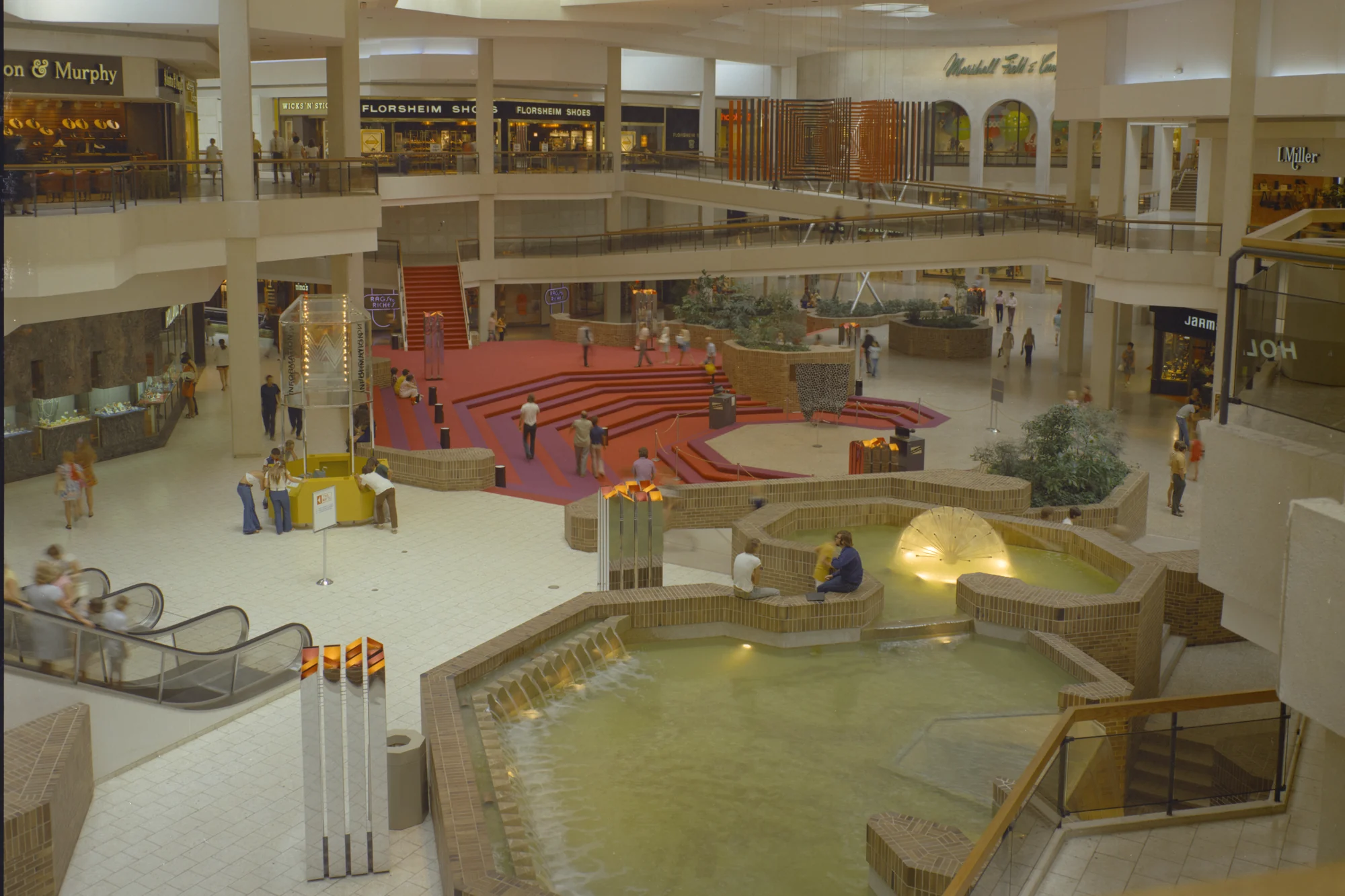
Because nowhere else would have them. A postwar American suburb offered a teenager without a driver’s licence almost no indoor space that was free to enter, open after school, climate-controlled, and not run by their parents or their school. The enclosed mall was all four at once.
Kathryn H. Anthony, then an assistant professor of architecture at the University of Illinois at Urbana-Champaign, ran the field study nobody else had bothered with. In “The Shopping Mall: A Teenage Hangout” (Adolescence, Summer 1985), she interviewed 51 adolescents at the Puente Hills Mall in Industry, California, spent ten hours observing their movement, and separately interviewed five merchants, two security staff and the mall’s manager.
Her respondents were emphatic that shopping was incidental. Asked why they came, only 53% said shopping. The remaining answers were looking for members of the opposite sex (11%), playing video games (7%), seeing friends, having fun and people-watching (6% each), eating (4%), and simply having “something to do” (4%). Asked what they liked best about the mall, 42% said being around other people.
They also came in packs. Anthony recorded that 83% arrived with friends, 9% went alone, and just 15% came with a parent. Her observers noted the shape of it: teenagers moved through the building in twos and threes, gathered at the central court, leaned on the second-floor railings, and spent almost no time at the edges. Some rode the escalators up and down to watch.
Anthony classified the mall as a third place in Ray Oldenburg’s sense — the ground that is neither home nor school. That framing is the reason the memory holds. For roughly fifteen years, a private shopping centre was the default third place for American adolescence.
Did the mall actually want teenagers there?
Yes, at first, and for reasons that had nothing to do with generosity. The enclosed mall was sold from the beginning as a substitute town centre, and a town centre with nobody standing around in it is a failed one.
Victor Gruen designed Southdale Center in Edina, Minnesota — the first fully enclosed, climate-controlled American mall, opened in 1956 — explicitly so that people would, in the International Council of Shopping Centers’ summary, get out of their cars and interact with each other. His early prototypes proposed folding public libraries and post offices into the retail. He spent his last years, before his death in 1980, publicly regretting how little of that survived.
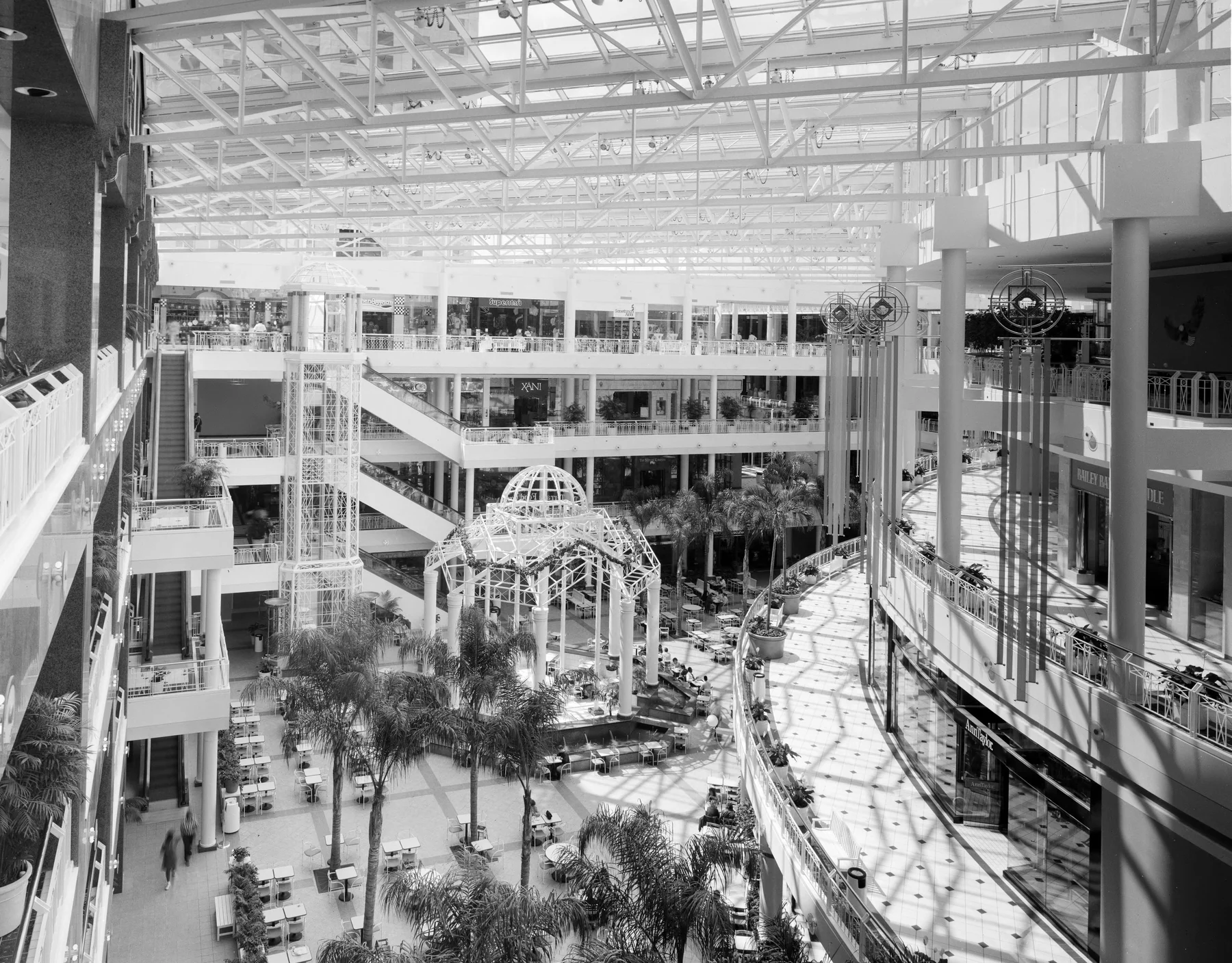
What survived was the shape without the civics: a sheltered pedestrian street, benches, fountains, planters, seating courts. Those are loitering infrastructure. A building furnished that way and then surprised that teenagers loiter in it is not being honest about its own floor plan.
There was also a straightforwardly commercial read. Anthony’s literature review cites a 1979 marketing analysis arguing that malls were an excellent place to promote products aimed at the teenage market, and a 1978 trade assessment observing that suburban shopping centres had “frequently become surrogate baby sitters” for children too young to drive — dropped off on Saturday afternoon and collected at five o’clock.
How much money did mall teenagers actually spend?
Not much, and the only researcher who measured it said so plainly. Anthony’s conclusion is the single most useful sentence written about the 1980s mall teenager: despite the enormous amount of time they spent in the building, teenagers did not spend much money in it, and hanging around the mall was “less a way to spend money than… a way of passing time.”
The numbers behind that are unflattering. Just over half (54%) spent only some of their visit shopping; 7% did not shop at all. When they did spend, it went on clothes (27%), food (24%), records (20%), drinks (13%) and video games (13%) — a basket that leans heavily on the lowest-margin, lowest-ticket tenants in the building.
Set that against the duration. Forty-four percent stayed three to five hours per visit; 14% stayed six hours or more; only 2% stayed under an hour. A department store wants a customer with a car boot and a chequebook for forty minutes. It was getting a fourteen-year-old with four dollars for five hours.
Every figure above is drawn from a linked source; the two mall-curfew figures are discussed in the sections below.
What was the mall buying by letting teenagers hang out for free?
Three things, none of them charity.
Occupancy that photographs as vitality. A mall’s product is not floor space; it is traffic. Its leases are commonly structured as percentage rent — a fixed base figure plus a share of each tenant’s gross sales above an agreed breakpoint — which ties the landlord’s income directly to how busy the building is. An empty concourse is a leasing problem before it is a sales problem. Teenagers filled the concourse at exactly the hours when adults were at work, at zero cost to the landlord.
The chauffeur effect. Anthony found that over three-quarters of her sample arrived by car and only about half held a driver’s licence. Someone drove them. The 1978 trade observation about surrogate babysitting cuts both ways: a mall that will absorb your child for an afternoon is a mall you will keep returning to.
A customer being trained. Teen-anchored specialty chains — record shops, shoe stores, arcades, fast food — were profitable tenants precisely because their customers were captive on site for hours. And a fourteen-year-old with four dollars becomes a twenty-four-year-old with a credit card in the same building.
None of this required anyone to like teenagers. It required only that the arithmetic hold. The interesting question is what happened when it stopped holding.
Was the mall ever a public place?
No. It looked like one and was never legally one, and that gap is the whole story.
In Lloyd Corp. v. Tanner (407 U.S. 551) the Supreme Court held in 1972 that a privately owned shopping centre had not dedicated itself to public use merely by inviting the public in, and could therefore bar Vietnam War protesters from handing out leaflets inside. Hudgens v. NLRB (1976) confirmed the position for picketing workers. The interior walkway that looks like a street is not a street.
Maureen O’Dougherty, writing in Environment and Planning D: Society and Space in 2006, put the consequence precisely: the mall is a space open to the public conditionally — a vast private space from which publics can be excluded, and into which they are admitted on terms set by marketing and security. She counted 21 states, Minnesota among them, that had upheld the 1972 ruling, against five (Oregon, California, Colorado, Massachusetts and New Jersey) where courts had found for citizens’ rights over property rights.
So the free afternoon was never a right, an entitlement, or a gift. It was a licence, granted silently, and revocable without notice. Most of the teenagers using it had no idea. When Mall of America announced its curfew in 1996, one told the Star Tribune that hanging out was what the mall was for — a sentence O’Dougherty notes gets the generation’s understanding exactly right and the property law exactly wrong.
When did the mall stop letting teenagers loiter free?
On the first weekend of October 1996, at the largest mall in the country, in public, with security posted on all 23 doors.
Mall of America opened in Bloomington, Minnesota in August 1992 and became the regional teen hangout almost immediately — it was unusually reachable by bus from across a metro area of 2.9 million, and off-peak fares were cheap. By the mid-1990s management was counting 2,000 to 3,000 unsupervised young people in the building on a weekend night, in groups running up to fifty.
The policy was announced on 20 June 1996 after a food-court fight, sold to parents over a summer-long public relations campaign, and took effect that October: nobody under 16 admitted after 6 p.m. on Friday or Saturday without an adult aged 21 or over. One adult could escort up to ten children. The Christian Science Monitor reported guards checking identification at every entrance of a 4.2 million square foot building drawing 40 million visitors a year.
It was not an original idea, and management never pretended otherwise. The same report has Mall of America devising its policy after examining two working examples: a mall in Asheville, North Carolina where a curfew had already been in force for three years, and one in Newport News, Virginia where adult escort rules had reportedly cut behaviour problems by 30 per cent. This was a tested operational playbook, adopted by the largest building in the category. Mall of America did not invent the mall curfew; it made it national.
The name mattered. It was not called a curfew or a ban; it was called a parental escort policy, which relocated the fault from the mall to the family. The mall’s spokeswoman, Teresa McFarland, argued the rule singled nobody out because it applied to every child equally. Its other public line was that unsupervised teenagers on weekend nights were a community problem, not a landlord’s problem — which is a defensible thing for a private business to say, and also an odd thing to say about a crowd the building had spent four years attracting.
It worked, on its own terms. The Christian Science Monitor reported that the mall had logged 300 youth “incidents” in 1995 and that the count of altercations afterwards fell to two.
The tell is in the scope. If the concern were children being unsupervised, the rule would have run every day. It ran on Friday and Saturday nights only — the two shifts when teenagers were the dominant crowd and the higher-spending visitor was being displaced. O’Dougherty notes the calculation directly: the policy would cost the mall money, but tourists were understood to spend roughly twice what locals did, and restricting the rule to weekends kept the loss small. That is not a child-welfare rule with a commercial side effect. It is a commercial rule with a child-welfare name.
Which malls restrict teenagers today?
Dozens, and the practice has hardened rather than faded. By 2007 the Monitor counted more than 40 US shopping centres with a “parental guidance required” rule; the International Council of Shopping Centers put the figure at 39 that year, 66 by 2010, and over 70 by 2013. New policies still arrive, and modern ones tend to be broader than the 1996 original — higher age ceilings, earlier start times, and every day rather than weekends.
| Mall | In force since | Terms | Source |
|---|---|---|---|
| Mall of America, Bloomington MN | October 1996 | Originally under 16 with an adult 21+ after 6 p.m. Friday and Saturday. Now under 16 with an adult 21+ from 3 p.m. daily; one adult may supervise up to 10 youths. | Mall of America |
| Parkway Place, Huntsville AL | 2006 | Under 18 with a parent or guardian 21+ after 6 p.m. Friday and Saturday. | NYRA |
| Parkdale Mall, Beaumont TX | 2017 | Under 18 with a parent or guardian 21+ after 6 p.m. Friday and Saturday; one adult per three youths; extends to the car parks. | NYRA |
| Crossgates Mall, Guilderland NY | Expanded to daily | Under 18 with a parent or guardian 21+ from 2 p.m. every day, including school hours. | NYRA |
| American Dream, East Rutherford NJ | Current | Under 16 with an adult 21+ from 4 p.m. until close. | NYRA |
The dissent is what proves the point. Simon Property Group — the largest retail landlord in the United States, with around 160 traditional malls — has declined to adopt escort policies at all but one of its centres. Its spokesman Les Morris told the Indianapolis Business Journal in 2013 that Simon did not think escort policies would work operationally and was philosophically opposed to them, on the reasoning that teenagers are customers. In the same piece, a marketing vice-president at rival CBL & Associates defended the opposite policy with a single line about its shoppers: “They come to shop; that is the key.”
Two of the largest landlords in the country, looking at the same demographic, reaching opposite conclusions on the same axis: does this crowd convert? Nobody in that argument is discussing whether teenagers deserve a place to be.
What does this change about how you remember the mall?
Not the memory. The memory is accurate: it really was free, it really was unsupervised, and for a decade and a half it really was the best available room. What changes is the reason.
The 1980s mall did not tolerate teenagers out of goodwill towards adolescence. It tolerated them because a busy concourse is worth more than an empty one, because the crowd cost nothing to acquire, and because no better use for those hours existed. When a better use appeared — a higher-spending visitor who found the crowd off-putting — the tolerance was withdrawn in a single announcement.
That pattern is not unique to teenagers. It is the standard behaviour of privately owned space that has been dressed as public space, and it is worth recognising because so much of contemporary life happens on that kind of ground. The freedom felt real because nobody had ever needed to enforce the limit. It was a licence the whole time.
The buildings are going the same way as the arrangement. Few conventional enclosed malls have been built in the United States since 2007. Their remains join the rest of the commercial landscape this site documents — the painted wall advertisements that outlived the businesses that ordered them, and the Depression-era sign crews whose work is still legible on brick a century later. All of it was commerce first, and only became landscape later.
Frequently asked questions
Why did teenagers hang out at the mall instead of somewhere else?
Because there was nowhere else that met all the conditions at once: free to enter, indoors, heated and cooled, open into the evening, reachable without a driving licence, and not supervised by parents or teachers. Kathryn Anthony’s 1985 study found teenagers went to the mall mainly to be around other people — only 53% named shopping as a reason at all.
Did malls make money from teenagers in the 1980s?
Less than the crowds suggested. Anthony concluded that hanging around the mall was for teenagers “less a way to spend money than… a way of passing time”: 7% did not shop at all, and spending clustered on clothes, food, records and arcade games. The value to the landlord was the traffic itself, since mall leases commonly tie the landlord’s income to tenant sales volume.
Was Mall of America the first mall to impose a teen curfew?
No, and its own managers said so at the time. The Christian Science Monitor reported in October 1996 that the mall devised its policy after examining a mall in Asheville, North Carolina where a curfew had already been in effect for three years — putting a working mall curfew there around 1993 — and another in Newport News, Virginia. ABC News’s later description of Mall of America as the first is therefore wrong. The Monitor’s own phrasing in 2007, “one of the nation’s first”, and Maureen O’Dougherty’s peer-reviewed statement that the mall followed other US shopping centres are both correct. What Mall of America did was make the practice national.
Could a mall legally throw teenagers out for doing nothing wrong?
Yes, in most of the United States. Lloyd Corp. v. Tanner (1972) held that a shopping centre does not become a public forum by inviting the public in. O’Dougherty counted 21 states upholding that position against five — Oregon, California, Colorado, Massachusetts and New Jersey — whose courts had found some citizens’ rights outweighing the owner’s property rights.
Did the Mall of America curfew actually reduce trouble?
By the mall’s own reported figures, sharply. It logged 300 youth “incidents” in 1995; the Christian Science Monitor reported the count of altercations afterwards falling to two. Those figures come from the party that adopted the policy and were not independently audited, and broader reviews of municipal youth curfews since 2002 have generally found little effect on crime.
Why is it called a “parental escort policy” and not a curfew?
Because the name assigns the responsibility. “Curfew” describes something the mall does to children; “parental escort policy” describes something parents have failed to do. Mall of America’s public argument in 1996 was that unsupervised teenagers were a community and family problem rather than a landlord’s, and the name carries that argument.
Do malls still restrict teenagers?
Yes, and more broadly than in 1996. The ICSC counted 39 US malls with curfew or escort policies in 2007, 66 in 2010 and over 70 by 2013, and new ones are still adopted. Several current policies apply to under-18s, start in the early afternoon, and run daily rather than at weekends. Simon Property Group, the largest US mall owner, is the notable holdout.
Methodology and sources
Primary sources. Two were read in full rather than summarised from search results. Kathryn H. Anthony’s “The Shopping Mall: A Teenage Hangout” (Adolescence, Vol. XX No. 78, Summer 1985, pp. 307–312) supplies every percentage attributed to teenagers here; its sample is 51 adolescents at the Puente Hills Mall in Industry, California, plus ten hours of behavioural observation and interviews with five merchants, two security staff and the mall manager. Maureen O’Dougherty’s “Public relations, private security: managing youth and race at the Mall of America” (Environment and Planning D: Society and Space, 2006, vol. 24, pp. 131–154) supplies the curfew’s chronology, the legal framing and the weekend-scope reasoning; it is based on a decade of local press review and over 100 hours of weekend fieldwork.
What was checked and what was left out. ABC News reported in 2010 that Mall of America was the first US mall with a teen curfew. That is wrong, and the correction comes from a contemporaneous source: the Christian Science Monitor of 9 October 1996 has mall management devising the policy after examining a curfew already three years old in Asheville, North Carolina, which matches O’Dougherty’s statement that the mall followed other shopping centres. An earlier draft of this article hedged the point as disputed; it is not disputed, and the article now states it. No fetchable source gives the exact day the policy commenced — the Monitor of Wednesday 9 October says it began “last weekend”, and secondary accounts widely give 4 October — so the article says “the first weekend of October 1996” rather than asserting a date no source states. The 300-to-two incident figures come from the Monitor’s 2007 follow-up, not its 1996 report, and are the mall’s own numbers; they are attributed as such, with the counter-evidence on curfew effectiveness stated alongside. The one page of the Anthony article that was missing from the archived scan is not quoted or relied on. Trade estimates of 1980s teenage spending power were found only in undated secondary aggregations and were dropped rather than repeated. Nothing in this article rests on a search-result snippet.
A note on race. O’Dougherty’s paper is centrally about the racial dynamics of who was excluded from Mall of America and how, including lawsuits settled before the curfew was announced. This article uses her chronology and legal analysis but does not attempt to summarise that argument; readers interested in it should go to the paper.
Images. Both photographs are real, documented images from the Library of Congress, each credited in its caption with photographer, date, catalogue link and rights status. Both are marked “no known restrictions on publication.” Nothing on this page is AI-generated: the two diagrams are hand-authored SVG, so their figures are readable text rather than pixels. The hero was cropped, not upscaled, from an 8236×10171 px master scan.
Internal linking. This site currently publishes two other articles, both linked above. The usual target of eight or more internal links is not met because that many relevant pages do not yet exist.
AI assistance. This article was researched and drafted with AI assistance, then fact-checked against the linked primary sources.