Why did every house have wood paneling? Because it was the cheapest finished wall in America — imported plywood fell to $70 per thousand square feet by 1957, a family could nail it up in a weekend, and by the 1980s a third of new houses got some. Then the price of looking cheap came due.
Key Takeaways
- The paneled room ran on imports. Hardwood plywood shipments from Asia began climbing in 1952 and passed American production in 1957 — most of it lauan peeled in Japan from Philippine logs, which by 1962 made up three-fourths of all imports — USDA Forest Service, 1965
- The price collapse made the wall. Imported plywood fell from about $125 per thousand square feet in 1951–52 to $70 by 1957, and the Forest Service credited cheap imports with creating the interior-paneling market outright.
- It was sold as luxury for the masses. U.S. Plywood’s 1957 Weldwood brochure pitched real hardwood walls that had been “beyond the reach of all but a handful of people, the very rich” — now prefinished, weekend-installable, and guaranteed for the life of the building.
- The peak was enormous. Americans used 5.16 billion square feet of hardwood plywood in 1972 and produced 7.8 billion square feet of hardboard in 1978; in the mid-1980s about one-third of all new houses still got some prefinished paneling — USDA Forest Products Laboratory, Marcin 1987
- Formaldehyde stained its name. In August 1984 HUD capped formaldehyde emissions from paneling plywood in manufactured homes and required a health notice on the wall; the Consumer Product Safety Commission’s own checklist for formaldehyde symptoms asks whether the house has been remodeled with “pressed-wood products (i.e., wall paneling)” — CPSC Publication 725
- The disappearance is measurable. A new single-family house used 4.5 cubic metres of nonstructural panel in 1986 and 2.0 in 1996 — less than half — on nearly identical housing starts — USDA Forest Service, GTR-207
Why did every house have wood paneling?
Because for about twenty-five years it was the cheapest way in America to turn a bare or ugly wall into a finished room — and the only way a homeowner could do it himself on a Saturday. A 4×8 sheet of prefinished plywood or hardboard needed no plasterer, no taping, no sanding and no paint. It went up over studs, over cracked plaster, over concrete block, and when the last panel was nailed the room was done.
The timing was perfect. In August 1954 TIME put “Do-it-Yourself” on its cover, and the historian Steven Gelber, reconstructing the era’s trade estimates, counted eleven million home workshops and four to six billion dollars a year of do-it-yourself spending by the mid-1950s. Gelber’s summary of the plywood aesthetic is exact: any man who could cut a straight line with a panel saw could furnish his whole house with it.
Paneling was that movement’s wall. It asked for the two skills every suburban father claimed — sawing and nailing — and it forgave everything else. The manufacturers understood this precisely, and priced, packaged and advertised the product as a weekend.
So the question in this article’s title has a supply-side answer and a demand-side answer, and they interlock. The supply side is a price collapse driven by imported plywood. The demand side is a new room — the den, the rec room, the finished basement — that postwar families wanted and could not otherwise afford to build. Paneling is what happened where the two met.
What was the wood-paneled room, exactly?
It went by different names in different houses: the den, the rec room, the rumpus room, the finished basement, later the family room. What the names shared was a function — the informal room, the one where the television lived and the children were allowed to make noise — and a location on the cheap side of the house, usually below grade or behind the garage.
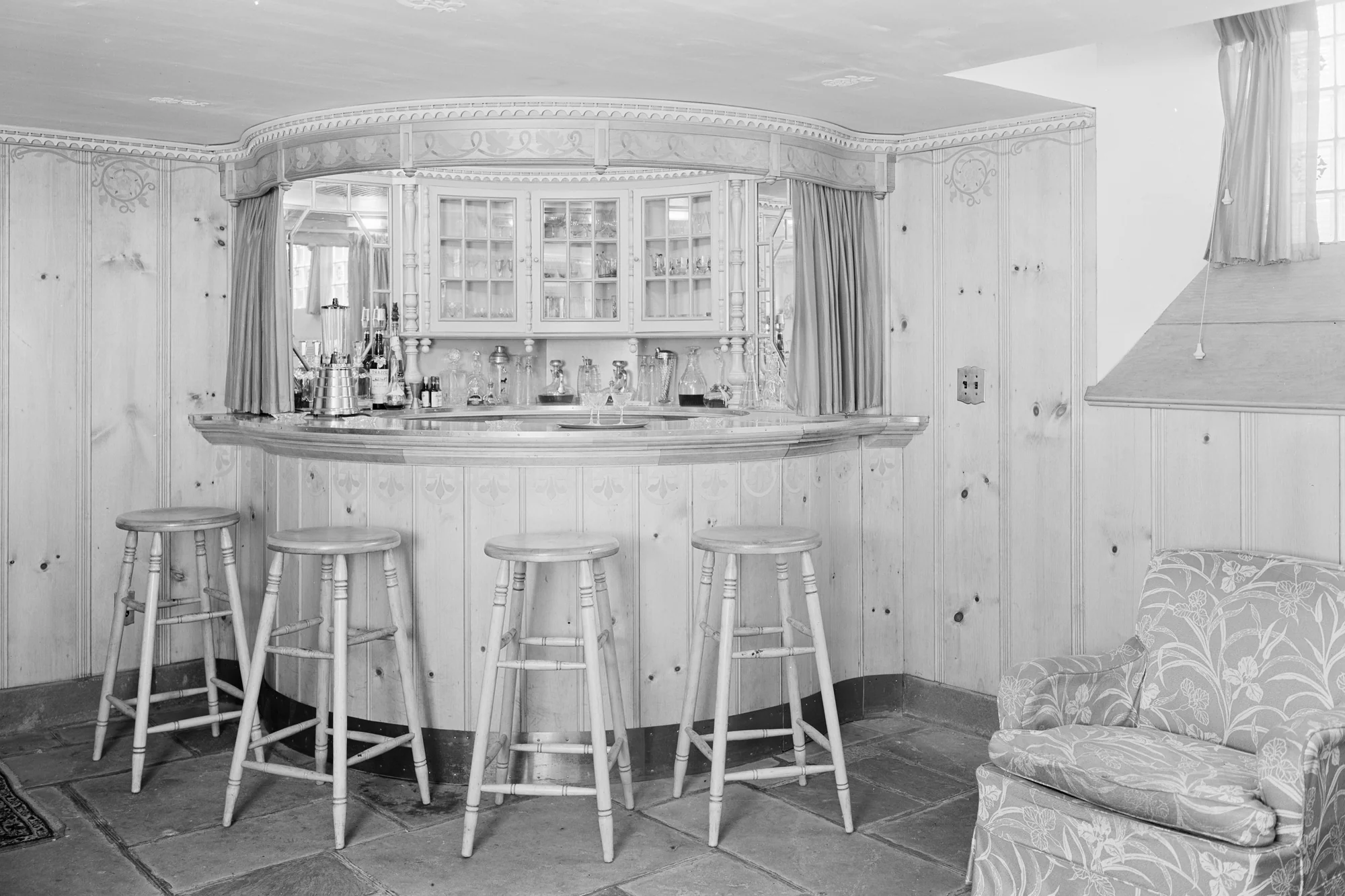
The room predates the boom. The knotty pine playroom in the photograph above was built in Nyack, New York, and photographed in 1941, complete with a curved pine bar — a one-off, carpenter-built luxury of exactly the kind the panel industry would spend the 1950s mass-producing. Knotty pine itself carried the look first: during the war, prefabricated housing was already being lined with it, as the promotional photograph below shows, and the Forest Service would later list knotty pine paneling among the finishes that plywood sheet was busy displacing.
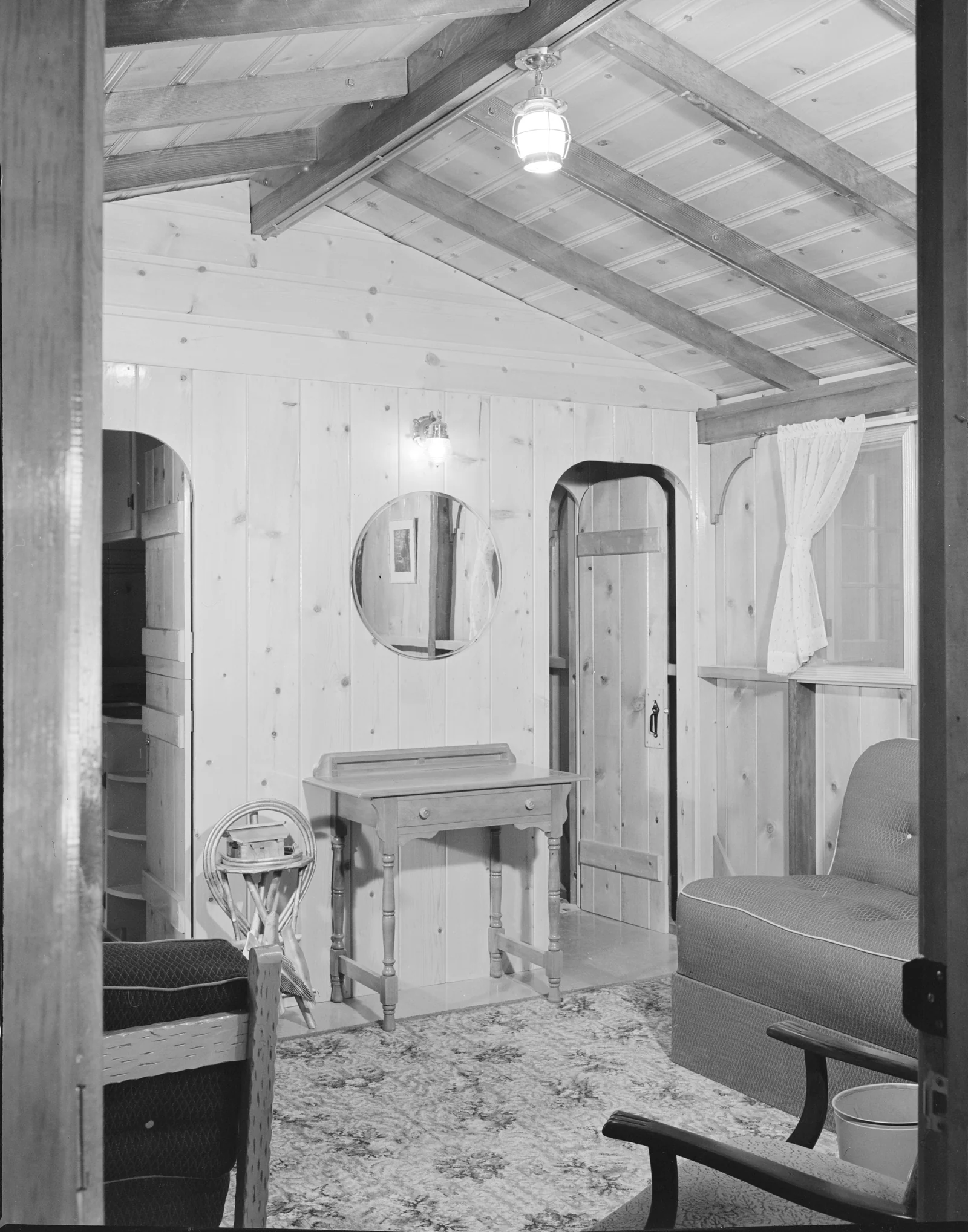
After the war the room acquired a social meaning. The architectural historian James A. Jacobs, in a study of the postwar family room summarised by JSTOR Daily, traces how a second living space oriented purely to leisure became a marker of middle-class arrival in the 1950s — and how the basement rec room was its budget location. A family that could not add a wing could finish a basement, and the finishing material was never in doubt.
Georgia-Pacific’s 1953 catalog for its Ripplewood paneling names the rooms outright: “You can ‘add-a-room’ in the attic, build a basement game-room or make that ‘corner-of-comfort’ den you’ve longed for — quickly and easily.” The suburb’s teenagers, when they outgrew that basement, moved on to the other free indoor room America built for them — but that is its own story.
How did wood paneling get so cheap?
Imports. The Forest Service’s own economists documented it as it happened: in a 1965 research paper, Siegel and Row reported that hardwood plywood shipments from abroad began rising in 1952 and had “exceeded domestic output since 1957”, supplying most of the rapid growth in American consumption.
The mechanism was price. The same paper puts the wholesale price of imported sheets at around $125 per thousand square feet in 1951–52 and $70 from 1957 on — with Japan taking market share in 1957 by cutting to $65 while other countries’ sheets sold at $110. Domestic prices fell too, the report notes, but not as fast.
The wood itself was lauan — “Philippine mahogany” in the showroom — peeled mostly in Japanese mills from logs cut in the Philippines. By 1962, the paper reports, lauan and its relatives were three-fourths of all hardwood plywood imports, and Asian mills were shipping panels already prefinished and even printed. The Forest Service’s conclusion could not be plainer: cheap imports “helped create two major new markets — flush doors and interior paneling.” The paneled den was not just supplied by the import boom; it was invented by it.
Below the plywood tier sat hardboard — the budget paneling, wood fiber pressed into sheet and printed with a photograph of grain. That material had been born in 1924, when an accidental steam-press mishap in William H. Mason’s Mississippi laboratory produced a hard, grainless board nobody had intended; his Laurel plant was running by 1926 and the company took the name Masonite in 1928. By the 1970s, printed hardboard and printed lauan were what most people meant by “wood paneling” — a wood-look product at a price plaster could not approach.
Who sold America the paneled den?
The industry’s advertising survives, and it is remarkably candid about the pitch: aristocracy, democratized. United States Plywood’s 1957 Weldwood brochure opens with the paneled halls of Europe and lands the punch in one sentence — a fine hardwood wall had been “beyond the reach of all but a handful of people, the very rich.” Now it came prefinished, “light in weight, easy to install,” at a fraction of the cost of lumber planks.
The 1959 Weldwood catalog added the two promises that closed the sale. Speed: “it takes only a few hours to install Weldwood Plywood Panels.” And permanence: interior-grade Weldwood was “guaranteed… for the life of the building in which it is installed.” Its prefinished plank line listed Philippine mahogany — lauan — alongside birch and walnut, the import economy hiding in plain sight on the species list.
The price ladder ran from aspirational to trivial. Surviving advertisements collected by Click Americana show Weldwood panels from $7.95 to $108 per 4×8 sheet across more than two dozen woods, and a quality wall of roughly twelve by eight feet advertised at about fifty dollars in materials. Marlite sold its hardboard version on upkeep — a “soil-proof wash-and-wear finish” — and 1950s real-estate listings touted paneled dens as selling points, which is worth remembering, because within thirty years the same feature would appear in listings as an apology.
How big did the paneling boom get?
Big enough that the federal government’s timber statisticians tracked it as a category. Forest Service surveys of new FHA-inspected houses found plywood use per square foot of floor area nearly doubling between 1959 and 1968, and hardboard use more than doubling, as sheet goods swallowed one interior job after another — McKeever and Phelps, Forest Products Journal, 1994.
The national totals peaked twice, once for each tier of the product. Hardwood plywood consumption hit 5.16 billion square feet in 1972, per the Forest Products Laboratory’s long-run statistical series RP-637; hardboard production peaked in 1978 at 7.8 billion square feet. And the habit outlived the fad: a Forest Service economist writing in 1987 could still report that “about one-third of all new houses use some type of prefinished panel.”
Every figure above is drawn from a linked source; the last card is the subject of the disappearance section below.
One more number locates the product socially. In 1976, mobile homes used a third more nonstructural panel per square metre of floor than site-built single-family houses — 0.037 cubic metres against 0.028, per the Forest Service’s end-use tables. Paneling was the wall of the manufactured home, and everyone knew it. That association would cost it dearly.
Why did wood paneling go out of style?
Because the thing it signalled flipped. A material sells as “luxury for less” only as long as it reads as luxury; the moment it reads as less, the same sheet on the same wall says the opposite. By the late 1970s, dark printed lauan was in every mobile home, every budget remodel and every basement in the country, and ubiquity did what ubiquity does.
The style press dates the turn to the 1980s. A recent Apartment Therapy history of the material puts it simply: the decade “ushered in a new wave of interior design and architecture with pastels, glass blocks, Memphis design” — light, bright and glossy, everything a brown wood wall was not. Drywall, by then the default wall of every American builder, took the rest: it was the blank canvas the new palette needed, and paneling’s one advantage over it — that you never had to paint — became a defect the moment people wanted to.
What followed was the paint-it-over era, and it never ended. The advice genre that began in newspaper home columns is now institutional: paint manufacturers themselves publish step-by-step guides to painting over paneling, framing it as the transformation of “a dated room.” The 1950s listings that advertised a paneled den and the 2020s listings that advertise “paneling freshly painted” are describing the same wall, fifty years apart.
Did formaldehyde kill wood paneling?
It did not kill it — the taste shift was already doing that — but it poisoned the name. The plywood and hardboard behind most paneling were bonded with urea-formaldehyde resins, and through the 1970s the gas they released indoors became a national health story, first through urea-formaldehyde foam insulation and then through the pressed-wood products themselves. The Consumer Product Safety Commission’s retrospective is blunt about the era: UF foam was “very popular” in the 1970s, and many treated homes showed high formaldehyde levels soon after installation — CPSC Publication 725.
Regulation followed, and it named the wall. In a rule published August 9, 1984, HUD capped formaldehyde emissions from plywood used in manufactured homes at 0.2 parts per million and particleboard at 0.3, required product certification — and required a formaldehyde health notice displayed in the home itself, per the Federal Register. A wall material that comes with a mandated warning placard has left the realm of cozy.
The CPSC’s consumer checklist for diagnosing formaldehyde symptoms asks, verbatim: “Has remodeling occurred using pressed-wood products (i.e., wall paneling)?” When a federal agency uses your product as the parenthetical example of the hazard, the marketing battle is over. The chemistry was eventually fixed — the same CPSC document records emissions cut 80–90% from 1980s levels, and Congress finished the job with the Formaldehyde Standards for Composite Wood Products Act in July 2010 — but the fix arrived decades after the customer had gone.
When did wood paneling disappear from new houses?
Between 1986 and 1996, and the federal end-use tables catch it happening. In 1976 a new single-family house consumed 4.5 cubic metres of nonstructural panel — the category covering hardwood plywood, hardboard and their kin; in 1986 the figure was still 4.5. By 1996 it was 2.0 — less than half — while single-family starts were nearly identical in the two survey years, 1.179 million against 1.161 million. Across all new housing the category fell from 6.6 million cubic metres to 3.4 — USDA Forest Service, GTR-207.
The industry that had built the wall dismantled itself in the same decade. Masonite, weakened by the early-1980s housing slump and undercut by newer board products, was bought by USG in 1988 for about $380 million and passed to International Paper soon after; a class action over failing hardboard siding ended in a $197.5 million settlement in 1997 — per the International Directory of Company Histories. Abitibi-Price, whose Kansas and North Carolina plants supplied interior wood paneling, sold its entire US building-products division in June 1992 for $100 million. Hardboard production, 7.8 billion square feet at the 1978 peak, was back down to its 1965 level by 2002.
| Year | What happened | Source |
|---|---|---|
| 1924–26 | William H. Mason’s steam-press accident yields hardboard; the first Masonite plant runs at Laurel, Mississippi | Company histories, USDA |
| 1952 | Hardwood plywood imports begin their climb | USDA Forest Service, 1965 |
| 1954 | TIME puts “Do-it-Yourself” on its cover, August 2 | TIME archive |
| 1957 | Imports pass American production; the wholesale price settles at $70 per thousand sq ft | USDA Forest Service, 1965 |
| 1972 | US hardwood plywood consumption peaks at 5.16 billion sq ft | USDA FPL, RP-637 |
| 1978 | US hardboard production peaks at 7.8 billion sq ft | USDA FPL, RP-637 |
| 1984 | HUD caps formaldehyde emissions from manufactured-home paneling and mandates an in-home health notice, August 9 | Federal Register |
| 1988 | USG buys a weakened Masonite for about $380 million | Company histories |
| 1992 | Abitibi-Price sells its US building-products division, interior paneling plants included | FundingUniverse |
| 1996 | Panel use per new single-family house measured at 2.0 m³ — half its 1986 level | USDA FS, GTR-207 |
| 2010 | Congress passes national formaldehyde standards for composite wood, July 7 | EPA |
| 2016 | Shiplap — solid, painted, nail-holes-and-all — becomes the fashionable wood wall via HGTV’s Fixer Upper | realtor.com, 2016 |
Is wood paneling coming back?
A version of it — but look closely at which version. The wood wall that returned in the 2010s was shiplap: solid boards, usually painted white, popularized by HGTV’s Fixer Upper, whose hosts Chip and Joanna Gaines used it constantly. A designer quoted by realtor.com in 2016 explained the appeal in words the Weldwood copywriters would have recognized: it is “reminiscent of a simpler time.”
The distinction matters. Shiplap and today’s slat walls are solid wood, light-toned or painted — the opposite, in every visual particular, of a dark printed lauan sheet. What came back was the idea of wood on the wall. The specific 4×8 product that once covered a third of new American houses came back nowhere, and no manufacturer is trying. Its rooms survive only where nobody has yet bothered to paint them.
Which is why the paneled den now belongs to the same landscape this site documents elsewhere — the terrazzo thresholds that outlived their shops and the painted wall ads that outlived their brands. It was commerce first: a price advantage wearing the costume of coziness. The price advantage moved on. The costume is still down in the basement, holding the smell of 1974.
Frequently asked questions
When was wood paneling most popular in American homes?
From the late 1950s through the late 1970s. Imported hardwood plywood passed American production in 1957, US hardwood plywood consumption peaked in 1972 at 5.16 billion square feet, and hardboard production peaked in 1978 at 7.8 billion square feet, per USDA Forest Service statistics. As late as the mid-1980s about one-third of new houses still used some prefinished paneling.
Why was wood paneling so popular in the 1970s?
Price, above all. Cheap lauan plywood from Asia and printed hardboard made a “wood” room the least expensive finished wall available, and it was the one wall treatment a homeowner could install personally — no plaster, no taping, no paint. The do-it-yourself boom that began in the 1950s supplied the labor for free.
Is 1970s wood paneling real wood?
Usually, but barely. The mainstream product was lauan plywood — sold as “Philippine mahogany” — often with a printed or photographic grain on its face, and the budget tier was hardboard: real wood fiber pressed into sheet and printed to look like boards. Solid-plank paneling like knotty pine existed but was the minority long before the 1970s.
Does old wood paneling contain formaldehyde?
Paneling of the 1960s–80s was typically bonded with urea-formaldehyde resins, and the CPSC identifies pressed-wood products of that era as significant formaldehyde sources — its symptom checklist names wall paneling specifically. Emissions decline steeply with age, and products made after the 2010 federal standards emit 80–90% less than 1980s levels, per the CPSC.
Why did people stop using wood paneling?
Three reasons stacked: 1980s taste moved to light, painted, glossy interiors; the material’s ubiquity in mobile homes and budget remodels made it read as cheap; and the formaldehyde story of the late 1970s and 1980s attached a health warning to its name. Federal end-use surveys show panel use per new house falling by more than half between 1986 and 1996.
Should you paint over wood paneling?
That is a taste question, but the industry answer has been institutionalized for decades: paint manufacturers publish official guides to painting paneling, and real-estate practice treats dark sheet paneling as something to neutralize before sale. The one consideration this article would add: solid knotty pine of the 1940s–50s is a different, scarcer material than 1970s printed lauan, and the two are worth telling apart before the primer comes out.
What is the difference between shiplap and 1970s wood paneling?
Construction and intent. Shiplap is solid boards with overlapping rabbeted edges, usually painted, installed one plank at a time; 1970s paneling was a 4×8 printed sheet whose entire purpose was to be the fastest, cheapest wall in the room. The 2010s shiplap revival popularized by Fixer Upper brought back wood walls as a premium texture — the inverse of the economics that built the paneled den.
Methodology and sources
Primary sources. The production, import, price and end-use figures here come from four USDA Forest Service publications read in full as PDFs: Siegel and Row’s 1965 research paper SO-17 on hardwood imports (the 1952 rise, the 1957 crossover, the $125-to-$70 price collapse, lauan’s share, and the finding that imports created the interior-paneling market); the Forest Products Laboratory’s statistical series RP-637 (the 1972 hardwood plywood consumption peak and the 1978 hardboard peak); McKeever and Phelps’ 1994 study of wood use in new houses (the 1959–68 per-house doubling); and general technical report GTR-207 (the per-house collapse from 4.5 to 2.0 cubic metres between 1986 and 1996, and the mobile-home figures). The era’s sales pitch is quoted from three manufacturer catalogs scanned in the Building Technology Heritage Library on archive.org — Georgia-Pacific 1953, and U.S. Plywood’s Weldwood brochures of 1957 and 1959 — and the formaldehyde history from the Federal Register, CPSC Publication 725 and the EPA.
What was checked and what was left out. TIME’s August 2, 1954 do-it-yourself cover was verified against TIME’s own cover archive, but the article text behind it is paywalled, so the mid-1950s DIY figures are taken from Steven Gelber’s peer-reviewed 1997 reconstruction, which cites its trade-press sources in full. No fetchable 1980s–90s newspaper column advising readers to paint their paneling could be retrieved, so the taste-shift account rests on dated retrospectives and present-day manufacturer guidance, and is framed as such. A retrospective with appealing but untraceable price figures (“$5 a sheet in 1968”) was found and rejected; the panel prices used instead are reprinted period advertisements. Corporate fates (the USG–Masonite sale, the Abitibi divestiture) come from published company-history reference works, which are secondary and attributed as such. Reddit was not mined for this piece: every claim standing here has a document behind it, and nostalgia threads would have added anecdote without evidence. Nothing in this article rests on a search-result snippet.
Images. Both photographs are real, documented images from the Library of Congress, credited in their captions with photographer, date, catalogue link and rights status — the 1941 Gottscho-Schleisner playroom (“no known restrictions on publication”) and the 1942 FSA/OWI war-housing interior (public domain). Both digitised negatives were mirror-reversed in the Library’s scans — the film-edge lettering reads backwards — and have been flipped to true orientation here; they were cropped and downscaled, never upscaled. Nothing on this page is AI-generated: the two diagrams are hand-authored SVG, so their figures are readable text rather than pixels.
Internal linking. This site publishes five other articles, three of which are linked above. The usual target of eight or more internal links is not met because that many relevant pages do not yet exist.
AI assistance. This article was researched and drafted with AI assistance, then fact-checked against the linked primary sources.